

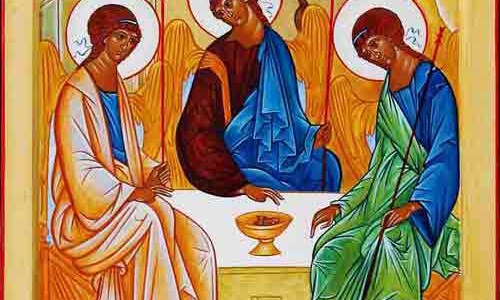
Solemnity of the Most Holy Trinity
Readings: Proverbs 8:22-31; Psalms 8:4-5, 6-7, 8-9; Romans 5:1-5; John 16:12-15;
In this brief excerpt from the Last Supper Discourse, the Lord teaches us something amazing today. He gives us a glimpse of the very nature of God. Like a lightening flash, he lights up for a split second the “structure” so to speak, of God.
The Holy Spirit, Jesus tells us, can only speak what he hears from the Son. And everything the Son has, he has received from the Father. That means that each one communicates their entire selves to the others. They don’t just share some points of view, information, or experiences: they actually communicate their whole selves, their entire divine persons.
What is God? God is a total unity of three persons, an everlasting community of living love, of mutual self-giving. There is no holding back, there are no hidden agendas, there is no manipulation – the inner life of God is absolute, no-holds-barred generosity, eternal and unlimited self-donation. That’s what God is: three perfect divine persons who perfectly share the unique divine nature.
How can this be? How can God be three distinct persons and still only be one God? We simply don’t know. We can only get an inkling of it from our human experience of life in a family. We are created in God’s image, and so the love that links husband and wife and gives rise to new life – this is a pale reflection of the divine family of the Blessed Trinity. Non-Christians often criticize this concept of the Trinity. They say it is a contradiction. But in fact the very mystery of it is a sign that it rings true. No merely human mind could have made this up; only God could have revealed it. And anyway, if we could understand God fully, he wouldn’t really be God.
Pentecost Sunday
Readings: Acts 2:1-11; Psalms 104:1, 24, 29-30, 31, 34; First Corinthians 12:3-7, 12-13; John 20:19-23;
The Church’s first Pentecost had some spectacular fireworks. The Apostles and other Christians were gathered “in one place together”. We don’t know exactly where. Probably it was somewhere inside or near the Temple in Jerusalem, since right after the fireworks, crowds started to gather. It may have been the same large room where Jesus and the Apostles had eaten the Last Supper. We are not certain.
So they were all in one place, and then a thunderous noise like a strong wind, like a tornado, came from the sky. And then flames appeared. Flames of fire just appeared out of nowhere, spontaneously, hovering in the air. And these flames divided up and started floating through the air until they came to rest on each of the people gathered. But the fireworks didn’t stop there. All of a sudden the Christians started speaking in languages that they didn’t know. A crowd had gathered by now, with visitors from all over the world who were in Jerusalem for the festival. Each one heard the Christians explaining the gospel in their own language.
It was a dramatic, spectacular display. But we would be wrong to conclude from this that the Holy Spirit’s normal way of acting in our life is through dramatic fireworks. In fact, it’s just the opposite. God’s action in our life is most often gentle and hardly perceptible at first. How does Jesus send the Spirit to his Apostles after his resurrection? He breathes on them – quietly and subtly. How does St Paul describe the action of the Holy Spirit in the Church? Like the soul of a body – powerful, essential, but invisible and subtle. The Holy Spirit works quietly.

Majales 3 – simply hilarious event…
Already third Majales at Slovak community in Sydney took place in Lidcombe on 18 of May 2013. Read more →
ASCENSION OF THE LORD
Readings: Acts 1:1-11; Psalms 47:2-3, 6-7, 8-9; Ephesians 1:17-23; Luke 24:46-53;
Bearing witness to Christ, to his message and the power of his goodness: this is our primary mission on earth. Before he ascended, Jesus didn’t say, “Go have a good time; go ‘find yourselves’.” No! He said, “Go be my witnesses to all the nations.” This is the mission we have been given. This is what we are supposed to do.
Each one of us will do it in a different way.
- God calls some to witness as priests.
- He calls some to consecrate their lives as full-time missionaries.
- Others are called to be leaven in the dough of the world, transforming culture from within, either as humble workers or as great leaders.
- Each of us he calls to bear witness by the sincerity, faithfulness, and loving-kindness with which we live out our normal responsibilities and relationships.
Right before Jesus ascended, St Luke tells us, he “raised his hands, and blessed them.” Then he ascended and his disciples “returned to Jerusalem with great joy.” Why were they joyful at Christ’s departure? Because Christ had revealed to them the purpose of their lives – they had a mission; their life had meaning.
Today, at Holy Communion, let’s accept anew our life’s mission, so that at the end of this Mass, when I [the priest] raise my hands so that Christ can bless you through me, our restlessness will be taken up into joy.
Sixth Sunday of Easter
Readings: Acts 15:1-2, 22-29; Psalms 67:2-3, 5, 6, 8; Revelation 21:10-14, 22-23; John 14:23-29
Today we are brought back to the night of the Last Supper. We take our places with the Twelve Apostles, gathered around the sacred table with Christ, Our Lord. We listen to his words, which are both mysterious and glorious. It is Christ’s last meal with his closest followers. He wants to leave them a parting gift. What is it? What does Christ want to bequeath to his Apostles at the Last Supper? Peace. “Peace I leave with you; my peace I give to you.” And what does he mean by peace? Not what we usually think: “Not as the world gives do I give it to you.”
Christ’s peace is lasting. It is interior peace of heart, which overflows into peace in families, in communities, in entire nations. It is the peace that comes from knowing without any doubt whatsoever that we are loved by him. It is the peace that comes from knowing without any doubt whatsoever that whenever we offend him, he will always be ready to forgive us. It is the peace that comes from knowing without any doubt whatsoever that we have a purpose in life, a mission – the very mission that Christ himself has given us: to spread his Kingdom. As today’s Psalm puts it, to “make his way known upon earth; among all nations, his salvation.


© Copyright - Slovak Catholic Community Sydney