

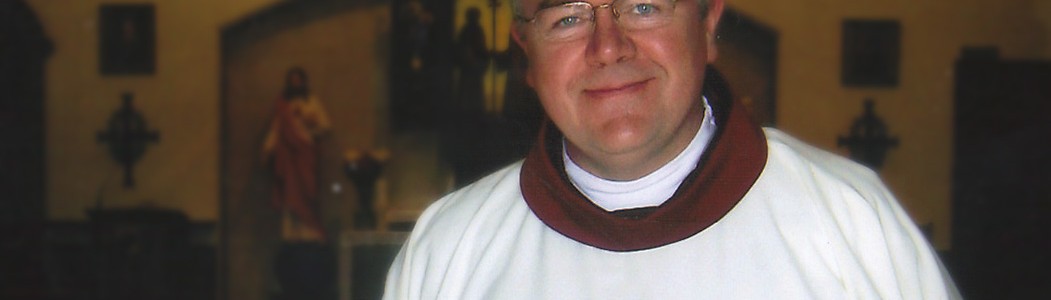
A kind Shepherd
It is coming close to a year since the spiritual needs of the Slovak Community have been entrusted to fr. Henry Adler, SVD. He was nominated into this position by his Provincial of the Divine Word Missionaries fr. Timothy Norton. Read more →
12th Sunday of Ordinary Time
Readings: Zechariah 12:10-11; Psalms 62:2, 3-4, 5-6, 8-9; Galatians 3:26-29; Luke 9:18-24;
In today’s gospel story Peter, speaking for himself and for the disciples, rightly confesses his faith in Jesus as the long-expected Messiah. When Jesus reveals to him and the disciples the implications of his being the Messiah they begin to draw back. By confessing Jesus as the Messiah the disciples show that they have gone above the level of the “people” who take Jesus to be nothing more than a prophet. Jesus then proceeds to tell them the implications of what they had just said: “The Son of Man must undergo great suffering, and be rejected by the elders, chief priests, and scribes, and be killed, and on the third day be raised.” (Luke 9:22).
Now, the disciples are not ready for this; they begin to withdraw. This withdrawing is more dramatic in the gospel of Matthew where Peter takes Jesus aside and tries to talk him out of the suffering and death he was destined to undergo. But in Luke’s version of the story which we read today focuses on the disciples as a whole and not particularly on Peter. This might explain why it does not include the dialogue and the incident between Jesus and Peter after Peter had made the all-important confession. Rather Luke shows the disciples pulling back from Jesus at his arrest, suffering and death, which shows that they do not understand the implication of the faith they profess in Jesus as the Messiah.
Peter and the disciples are to be commended for the courage to think for themselves. Jesus shows that he expects his followers to think for themselves when he asks them first, “Who do the crowds say that I am?” (verse 18), and then the all-important question: “But who do you say that I am?” (verse 20). Disciples must inform themselves on what the current thinking is on any given issue. One can achieve that by reading books, listening to the radio, watching the television and surfing the internet. Over and above that, disciples must then, in light of Christian faith and revelation, make up their minds on the issue.
What do you hear from people about Jesus? What impact does it have on your personal faith and the faith of your family, community and “your world?” Who is Jesus for you?
11th Sunday of Ordinary Time
Readings: Second Samuel 12:7-10, 13; Psalms 32:1-2, 5, 7, 11; Galatians 2:16, 19-21; Luke 7:36–8:3 or 7:36-50;
Jesus allows this sinful woman to come close to him, to have direct contact with him. And then he administers his forgiveness through real words spoken with a real, audible voice. This was incomprehensible to Simon the Pharisee. First of all, only God had the authority to forgive sins (and Simon didn’t think Jesus was God). But even more than that, the whole encounter was too mundane, too down-to-earth. Simon was convinced that God was too spiritual for that kind of thing. Not even a prophet would let such a sinful woman come that close, would lower himself to that level.
And yet, Jesus is glad that she has come. Jesus knew that it was hard for the woman to admit her weakness and neediness in front of other people. But it was the best thing for her to do. Only in that context was she able to express physically, humanly, through her tears and the ointment, her sorrow for her sins, her trust and confidence in his mercy. And only in that context was Jesus able to speak audibly and unmistakably his words of love and forgiveness.
After this encounter, she would never have to doubt God’s forgiveness. She could always point back to that specific moment, in real time and space, as her new beginning. If she had been an angel, she wouldn’t have wanted to show her love and repentance with tears and anointing. If she had been an angel, it would have been appropriate for God to speak directly to her heart without any human mediation.
But she wasn’t an angel. And neither are we. We have the same need she had. And God knows it. That’s why he has given us the sacrament of confession.

10th Sunday of Ordinary Time
Readings: First Kings 17:17-24; Psalms 30:2, 4, 5-6, 11, 12, 13; Galatians 1:11-19; Luke 7:11-17;
The lesson of this encounter between Jesus and the widow of Nain is so simple that we may miss it: God cares. “Do not cry,” Jesus tells her, as if to say, “I can’t bear to see you suffer like this. Let me help. ”This woman had lost her husband, now she has lost her only son – she is alone, suffering without hope. And then she meets Jesus, and he simply can’t let her suffer alone, and so he performs a miracle. No one asked him to perform this miracle; he took the initiative to intervene.
The Christian God is not a God who remains aloof: he does not keep his distance; he cares too much about us, in spite of our sinfulness, weakness, and brokenness. This is the message of every page of the Gospels, from Christmas to Calvary: God cares; he has compassion on us; he suffers with us, giving meaning to our pain.
Sometimes we feel like we are suffering alone, as if God doesn’t care. Sometimes Christ seems far away, because he doesn’t give us the miracle we long for. But we can’t let those feelings deceive us. This widow did not know about Calvary. She had never seen a crucifix. The only way Christ had to show her his compassion was through a miracle.
But we have seen Calvary. We know to what depths God’s compassion has gone. And we can always go to the Tabernacle, where we find the Eucharist, the living memorial of Calvary – the revelation of God’s unfathomable compassion, his “suffering with” each and every one of us.
Truly, we never have to suffer alone. And so, when we choose to do so anyway, we not only increase our own pain, but we double Christ’s as well, by turning a blind eye to his cross.
Solemnity of The Body and Blood of Christ
Readings: Genesis 14:18-20; Psalms 110:1, 2, 3, 4; First Corinthians 11:23-26; Luke 9:11-17;
St Luke paints a down-to-earth picture of Jesus walking the dusty trails of Palestine, “speaking to the crowds about the Kingdom of God,” “healing those who needed to be cured”, and even making sure they had enough to eat. This picture shows how close Jesus wants to be to us. That’s a central message of today’s feast of the Body and Blood of Christ.
Back in first century Palestine, Jesus spent all his time doing things for others. His whole life was for others, for us. He came for us; he came to be our Savior and to be the Friend who will never let us down. And he wanted to make sure that we would never forget that. So he figured out a way to remain with us even after he died, rose, and ascended into heaven.
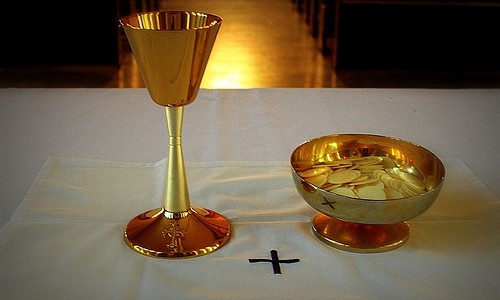
He has remained with us not only in the holy Scriptures, not only in the living Church, not only in the examples of the saints, but even under the humble and silent appearances of bread and wine. In the Eucharist, he is as close to us as he was to those people who walked with him on the dusty roads of Palestine. In fact, he is even closer. Those people received bread at his hands, but we receive the Lord himself in Holy Communion.
What more could Jesus have done to show us how passionately he wants to be near us, to guide us, to strengthen us? Jesus has not changed since the day he multiplied the loaves for the hungry crowds. He has not all of a sudden become selfish, harsh, and unforgiving. He is as good and generous now as he was then.
If Jesus has chosen to stay close to us, it is because we need him to be close to us. Jesus has stayed among us in the Eucharist, body, blood, soul and divinity. Today let’s thank him for this great gift, from the bottom of our hearts, and when he comes to us again in Holy Communion, let’s promise him that from now on we will make better use of it, even just a little bit better.


© Copyright - Slovak Catholic Community Sydney