

12th Sunday of Ordinary Time
Readings: Zechariah 12:10-11; Psalms 62:2, 3-4, 5-6, 8-9; Galatians 3:26-29; Luke 9:18-24;
In today’s gospel story Peter, speaking for himself and for the disciples, rightly confesses his faith in Jesus as the long-expected Messiah. When Jesus reveals to him and the disciples the implications of his being the Messiah they begin to draw back. By confessing Jesus as the Messiah the disciples show that they have gone above the level of the “people” who take Jesus to be nothing more than a prophet. Jesus then proceeds to tell them the implications of what they had just said: “The Son of Man must undergo great suffering, and be rejected by the elders, chief priests, and scribes, and be killed, and on the third day be raised.” (Luke 9:22).
Now, the disciples are not ready for this; they begin to withdraw. This withdrawing is more dramatic in the gospel of Matthew where Peter takes Jesus aside and tries to talk him out of the suffering and death he was destined to undergo. But in Luke’s version of the story which we read today focuses on the disciples as a whole and not particularly on Peter. This might explain why it does not include the dialogue and the incident between Jesus and Peter after Peter had made the all-important confession. Rather Luke shows the disciples pulling back from Jesus at his arrest, suffering and death, which shows that they do not understand the implication of the faith they profess in Jesus as the Messiah.
Peter and the disciples are to be commended for the courage to think for themselves. Jesus shows that he expects his followers to think for themselves when he asks them first, “Who do the crowds say that I am?” (verse 18), and then the all-important question: “But who do you say that I am?” (verse 20). Disciples must inform themselves on what the current thinking is on any given issue. One can achieve that by reading books, listening to the radio, watching the television and surfing the internet. Over and above that, disciples must then, in light of Christian faith and revelation, make up their minds on the issue.
What do you hear from people about Jesus? What impact does it have on your personal faith and the faith of your family, community and “your world?” Who is Jesus for you?
11th Sunday of Ordinary Time
Readings: Second Samuel 12:7-10, 13; Psalms 32:1-2, 5, 7, 11; Galatians 2:16, 19-21; Luke 7:36–8:3 or 7:36-50;
Jesus allows this sinful woman to come close to him, to have direct contact with him. And then he administers his forgiveness through real words spoken with a real, audible voice. This was incomprehensible to Simon the Pharisee. First of all, only God had the authority to forgive sins (and Simon didn’t think Jesus was God). But even more than that, the whole encounter was too mundane, too down-to-earth. Simon was convinced that God was too spiritual for that kind of thing. Not even a prophet would let such a sinful woman come that close, would lower himself to that level.
And yet, Jesus is glad that she has come. Jesus knew that it was hard for the woman to admit her weakness and neediness in front of other people. But it was the best thing for her to do. Only in that context was she able to express physically, humanly, through her tears and the ointment, her sorrow for her sins, her trust and confidence in his mercy. And only in that context was Jesus able to speak audibly and unmistakably his words of love and forgiveness.
After this encounter, she would never have to doubt God’s forgiveness. She could always point back to that specific moment, in real time and space, as her new beginning. If she had been an angel, she wouldn’t have wanted to show her love and repentance with tears and anointing. If she had been an angel, it would have been appropriate for God to speak directly to her heart without any human mediation.
But she wasn’t an angel. And neither are we. We have the same need she had. And God knows it. That’s why he has given us the sacrament of confession.
10th Sunday of Ordinary Time
Readings: First Kings 17:17-24; Psalms 30:2, 4, 5-6, 11, 12, 13; Galatians 1:11-19; Luke 7:11-17;
The lesson of this encounter between Jesus and the widow of Nain is so simple that we may miss it: God cares. “Do not cry,” Jesus tells her, as if to say, “I can’t bear to see you suffer like this. Let me help. ”This woman had lost her husband, now she has lost her only son – she is alone, suffering without hope. And then she meets Jesus, and he simply can’t let her suffer alone, and so he performs a miracle. No one asked him to perform this miracle; he took the initiative to intervene.
The Christian God is not a God who remains aloof: he does not keep his distance; he cares too much about us, in spite of our sinfulness, weakness, and brokenness. This is the message of every page of the Gospels, from Christmas to Calvary: God cares; he has compassion on us; he suffers with us, giving meaning to our pain.
Sometimes we feel like we are suffering alone, as if God doesn’t care. Sometimes Christ seems far away, because he doesn’t give us the miracle we long for. But we can’t let those feelings deceive us. This widow did not know about Calvary. She had never seen a crucifix. The only way Christ had to show her his compassion was through a miracle.
But we have seen Calvary. We know to what depths God’s compassion has gone. And we can always go to the Tabernacle, where we find the Eucharist, the living memorial of Calvary – the revelation of God’s unfathomable compassion, his “suffering with” each and every one of us.
Truly, we never have to suffer alone. And so, when we choose to do so anyway, we not only increase our own pain, but we double Christ’s as well, by turning a blind eye to his cross.
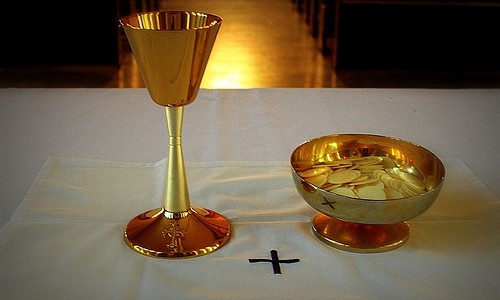
Solemnity of The Body and Blood of Christ
Readings: Genesis 14:18-20; Psalms 110:1, 2, 3, 4; First Corinthians 11:23-26; Luke 9:11-17;
St Luke paints a down-to-earth picture of Jesus walking the dusty trails of Palestine, “speaking to the crowds about the Kingdom of God,” “healing those who needed to be cured”, and even making sure they had enough to eat. This picture shows how close Jesus wants to be to us. That’s a central message of today’s feast of the Body and Blood of Christ.
Back in first century Palestine, Jesus spent all his time doing things for others. His whole life was for others, for us. He came for us; he came to be our Savior and to be the Friend who will never let us down. And he wanted to make sure that we would never forget that. So he figured out a way to remain with us even after he died, rose, and ascended into heaven.
He has remained with us not only in the holy Scriptures, not only in the living Church, not only in the examples of the saints, but even under the humble and silent appearances of bread and wine. In the Eucharist, he is as close to us as he was to those people who walked with him on the dusty roads of Palestine. In fact, he is even closer. Those people received bread at his hands, but we receive the Lord himself in Holy Communion.
What more could Jesus have done to show us how passionately he wants to be near us, to guide us, to strengthen us? Jesus has not changed since the day he multiplied the loaves for the hungry crowds. He has not all of a sudden become selfish, harsh, and unforgiving. He is as good and generous now as he was then.
If Jesus has chosen to stay close to us, it is because we need him to be close to us. Jesus has stayed among us in the Eucharist, body, blood, soul and divinity. Today let’s thank him for this great gift, from the bottom of our hearts, and when he comes to us again in Holy Communion, let’s promise him that from now on we will make better use of it, even just a little bit better.
Solemnity of the Most Holy Trinity
Readings: Proverbs 8:22-31; Psalms 8:4-5, 6-7, 8-9; Romans 5:1-5; John 16:12-15;
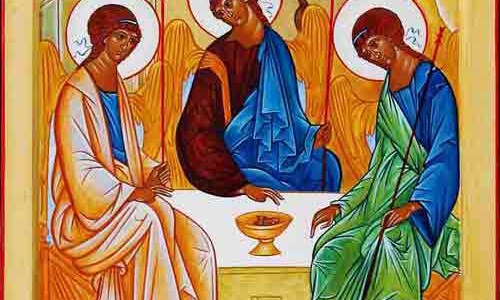
In this brief excerpt from the Last Supper Discourse, the Lord teaches us something amazing today. He gives us a glimpse of the very nature of God. Like a lightening flash, he lights up for a split second the “structure” so to speak, of God.
The Holy Spirit, Jesus tells us, can only speak what he hears from the Son. And everything the Son has, he has received from the Father. That means that each one communicates their entire selves to the others. They don’t just share some points of view, information, or experiences: they actually communicate their whole selves, their entire divine persons.
What is God? God is a total unity of three persons, an everlasting community of living love, of mutual self-giving. There is no holding back, there are no hidden agendas, there is no manipulation – the inner life of God is absolute, no-holds-barred generosity, eternal and unlimited self-donation. That’s what God is: three perfect divine persons who perfectly share the unique divine nature.
How can this be? How can God be three distinct persons and still only be one God? We simply don’t know. We can only get an inkling of it from our human experience of life in a family. We are created in God’s image, and so the love that links husband and wife and gives rise to new life – this is a pale reflection of the divine family of the Blessed Trinity. Non-Christians often criticize this concept of the Trinity. They say it is a contradiction. But in fact the very mystery of it is a sign that it rings true. No merely human mind could have made this up; only God could have revealed it. And anyway, if we could understand God fully, he wouldn’t really be God.
Pentecost Sunday
Readings: Acts 2:1-11; Psalms 104:1, 24, 29-30, 31, 34; First Corinthians 12:3-7, 12-13; John 20:19-23;
The Church’s first Pentecost had some spectacular fireworks. The Apostles and other Christians were gathered “in one place together”. We don’t know exactly where. Probably it was somewhere inside or near the Temple in Jerusalem, since right after the fireworks, crowds started to gather. It may have been the same large room where Jesus and the Apostles had eaten the Last Supper. We are not certain.
So they were all in one place, and then a thunderous noise like a strong wind, like a tornado, came from the sky. And then flames appeared. Flames of fire just appeared out of nowhere, spontaneously, hovering in the air. And these flames divided up and started floating through the air until they came to rest on each of the people gathered. But the fireworks didn’t stop there. All of a sudden the Christians started speaking in languages that they didn’t know. A crowd had gathered by now, with visitors from all over the world who were in Jerusalem for the festival. Each one heard the Christians explaining the gospel in their own language.
It was a dramatic, spectacular display. But we would be wrong to conclude from this that the Holy Spirit’s normal way of acting in our life is through dramatic fireworks. In fact, it’s just the opposite. God’s action in our life is most often gentle and hardly perceptible at first. How does Jesus send the Spirit to his Apostles after his resurrection? He breathes on them – quietly and subtly. How does St Paul describe the action of the Holy Spirit in the Church? Like the soul of a body – powerful, essential, but invisible and subtle. The Holy Spirit works quietly.
ASCENSION OF THE LORD
Readings: Acts 1:1-11; Psalms 47:2-3, 6-7, 8-9; Ephesians 1:17-23; Luke 24:46-53;
Bearing witness to Christ, to his message and the power of his goodness: this is our primary mission on earth. Before he ascended, Jesus didn’t say, “Go have a good time; go ‘find yourselves’.” No! He said, “Go be my witnesses to all the nations.” This is the mission we have been given. This is what we are supposed to do.
Each one of us will do it in a different way.
- God calls some to witness as priests.
- He calls some to consecrate their lives as full-time missionaries.
- Others are called to be leaven in the dough of the world, transforming culture from within, either as humble workers or as great leaders.
- Each of us he calls to bear witness by the sincerity, faithfulness, and loving-kindness with which we live out our normal responsibilities and relationships.
Right before Jesus ascended, St Luke tells us, he “raised his hands, and blessed them.” Then he ascended and his disciples “returned to Jerusalem with great joy.” Why were they joyful at Christ’s departure? Because Christ had revealed to them the purpose of their lives – they had a mission; their life had meaning.
Today, at Holy Communion, let’s accept anew our life’s mission, so that at the end of this Mass, when I [the priest] raise my hands so that Christ can bless you through me, our restlessness will be taken up into joy.
Sixth Sunday of Easter
Readings: Acts 15:1-2, 22-29; Psalms 67:2-3, 5, 6, 8; Revelation 21:10-14, 22-23; John 14:23-29
Today we are brought back to the night of the Last Supper. We take our places with the Twelve Apostles, gathered around the sacred table with Christ, Our Lord. We listen to his words, which are both mysterious and glorious. It is Christ’s last meal with his closest followers. He wants to leave them a parting gift. What is it? What does Christ want to bequeath to his Apostles at the Last Supper? Peace. “Peace I leave with you; my peace I give to you.” And what does he mean by peace? Not what we usually think: “Not as the world gives do I give it to you.”
Christ’s peace is lasting. It is interior peace of heart, which overflows into peace in families, in communities, in entire nations. It is the peace that comes from knowing without any doubt whatsoever that we are loved by him. It is the peace that comes from knowing without any doubt whatsoever that whenever we offend him, he will always be ready to forgive us. It is the peace that comes from knowing without any doubt whatsoever that we have a purpose in life, a mission – the very mission that Christ himself has given us: to spread his Kingdom. As today’s Psalm puts it, to “make his way known upon earth; among all nations, his salvation.
Fifth Sunday of Easter
Readings: Acts 14:21-27; Psalms 145:8-9, 10-11, 12-13; Revelation 21:1-5; John 13:31-33, 34-35;
During the seven weeks long Easter season we have the time to reflect on those lessons Christ taught us in his passion and resurrection. Plants have to spend time outside to gradually absorb the sunlight and transform it into nutrients. Just so, our souls have to spend time basking in the light of Christ’s revelation, so that we can absorb the grace God wants to give us.
Today especially, we are reminded of the New Commandment that Christ gave us the day before he suffered. We are brought back to that Last Supper, when Jesus was gathered with his closest companions and opened his heart to them. It was the night when his heart overflowed with love as it never had before. It was the night when he revealed the secret identity of every Christian, the distinguishing mark: “This is how all will know that you are my disciples,” he said, “if you have love for one another.” And not just any kind of love, but Christ-like love: “I give you a new commandment… As I have loved you, so you also should love one another.”
Being a Christian is much more than being a member of a club. Being a Christian means having an urgent, important mission in life. It means being another Christ in the world. Jesus gave his very life in order to fulfill his Father’s will and win salvation for sinners. Each one of us is called to reproduce in the unique circumstances of our lives that exact same pattern: dedicating our lives to discovering and fulfilling God’s will, and striving to help as many people as possible know, love, and follow Christ.
Today, the Church invites us to ask ourselves if we have really decided to follow Christ’s New Commandment. Sometimes we think this New Commandment is only for people who are already saints. It isn’t. It’s the path to sanctity. Sometimes we think this commandment is too difficult to be realistic. But if it were, Christ would not have issued it.
Today, let’s choose Christ; let’s make the decision, once and for all.


© Copyright - Slovak Catholic Community Sydney